The same things you do today,
with guardrails.
Disbo does nothing your firm does not already do. It does it with more verification, more controls and a full record, so the answer to the bar is on screen.
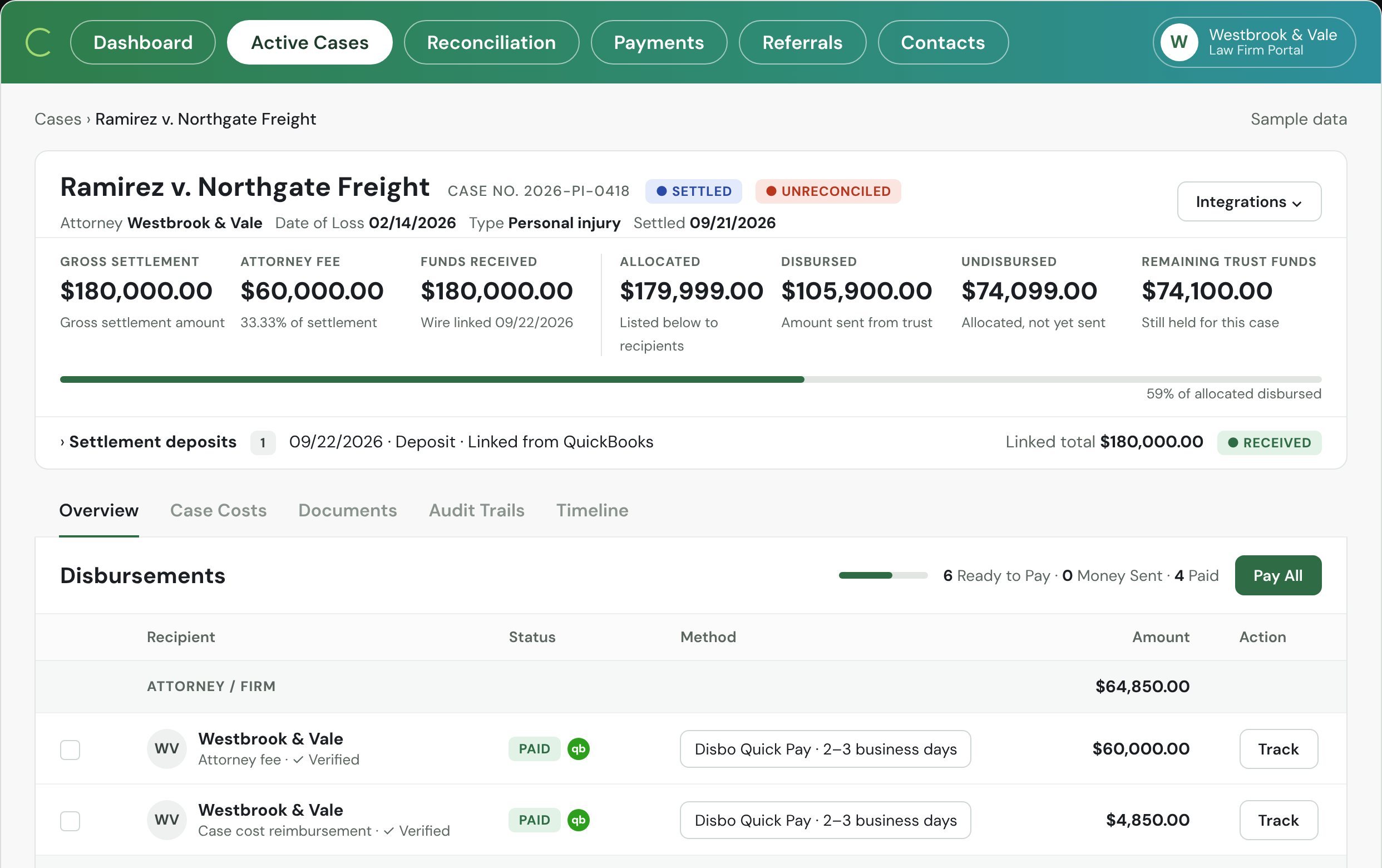
What it does
Controls you can point to. Supports compliance by recording and flagging.
Limit who can release money
Not every user can send.Viewers see, operators queue, signers release with a second factor.
Stop a sheet that does not balance
No payee can exceed the ledger.Pay turns grey when a line changes by one dollar.
Pay from your own IOLTA
Disbo never holds client funds.Checks draw on your IOLTA; our fee is never taken from trust.
Log every action
No side record of who did what.The log shows who prepared, who released, when and from where.
Export the month
No rebuilding the workbook.Reconciliation (beta) exports statement, journal, ledger summary, exceptions.
The screen
A case, to the penny. The case overview.
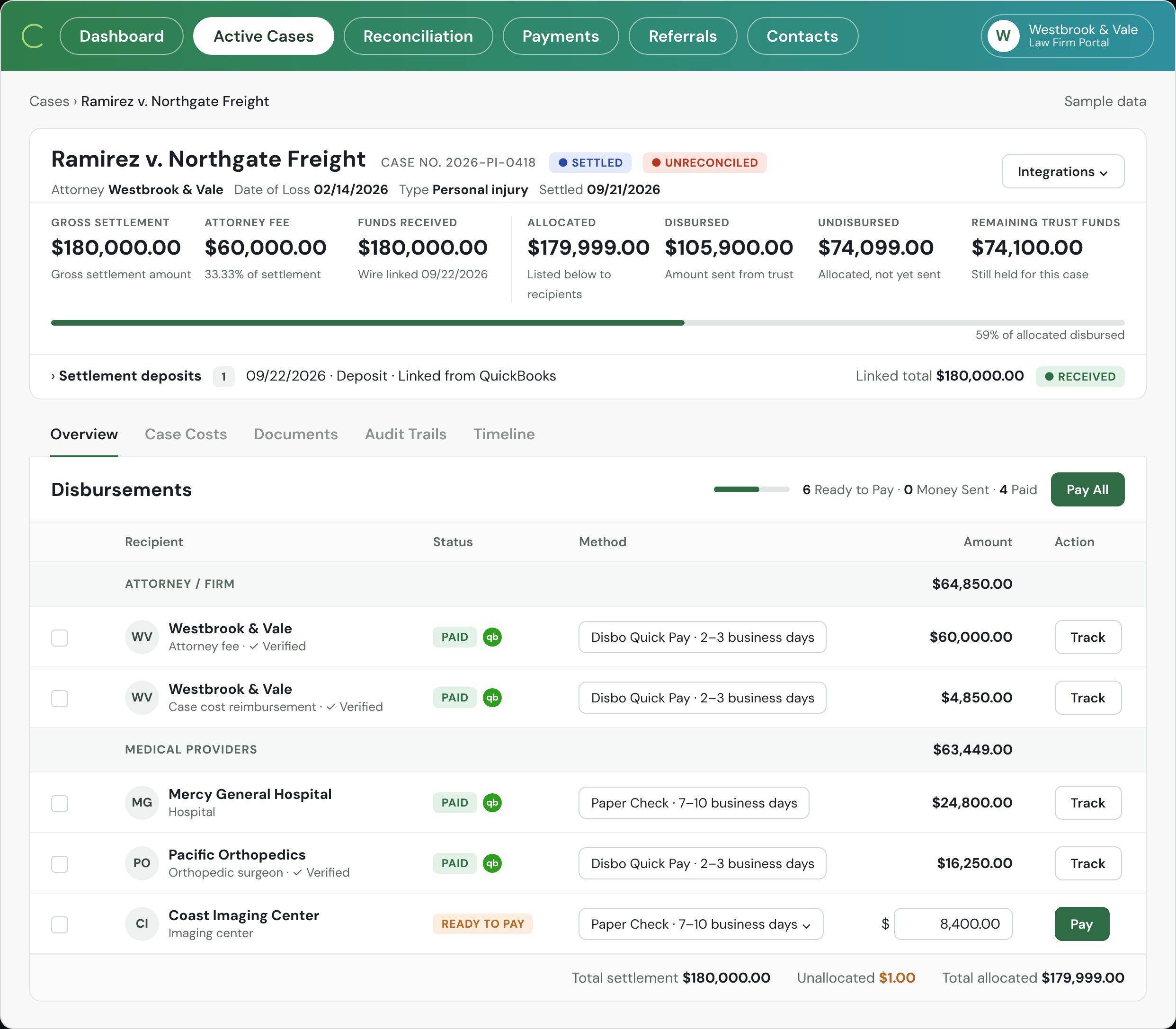
- Total settlement, total allocated and Unallocated $1.00.
- Pay All, and a Pay button on each ready recipient.
- Status and method on every recipient.
What it solves
Questions a partner asks. Each answer is a screen, not a promise.
Who can move money?
Named signers only, with a second factor. The role list is a screen; the releases are on the log.
On the screen: Settings › Roles; Audit log.
Does every client ledger balance?
Each matter has its own ledger. None can go negative through Disbo; an existing one shows as an exception to fix.
On the screen: Dashboard; Reconciliation (beta).
Where is the money between release and payee?
In your IOLTA until it leaves, then with the payee. ACH passes through a regulated bank account for seconds, never a Disbo balance.
On the screen: Payments; the bank statement.
Can you show me the month?
The reconciliation workbook by month: statement, journal, ledger summary, exceptions, sign-off. One export.
What the bar asks about.
Three questions a managing partner asks before a dollar moves. Tap one.
Who holds the money?
No one. Most payouts are checks, drawn on your IOLTA and cleared by your bank like any check you write today. The rest are electronic payments that pass through our banking partner instantly and never sit anywhere or earn interest. Disbo holds nothing; it is software, like your bank's bill pay.
Who has looked at this?
The flow of funds has been reviewed with the State Bar of California and IOLTA.org. Fees come only from operating. Every payout is tied to a case and a payee. Disbo charges nothing to your clients and has no law firm investors.
Who can see our documents and bank details?
Privileged firm documents are accessible only to a two-person, US-based support team under NDA. Payees link their own bank through Plaid with a government ID on file, so routing and account numbers never live in Disbo and an emailed bank change can't change anything.
Questions about compliance.
Is Disbo compliant with California (or my state) trust-account rules?
The rules govern the firm's handling of client funds, and Disbo changes none of the underlying actions. Checks are drawn on your IOLTA, ACH is a payout you authorize, fees come from operating, never trust, and every dollar stays traceable to a client and a case. Requirements vary by state and the firm remains responsible; we reviewed the flow of funds with the State Bar of California and IOLTA.org.
Who is responsible for compliance?
The firm, as today. Disbo is a tool the firm uses to meet its obligations. We do not claim certification by any state bar.
Is there an audit trail for the state bar?
Who approved what, when, for which case, from which account, with the bank transaction it matched to. Exportable per case or per account. Uncashed checks and unmatched deposits are listed and aged.
What if Disbo gets hacked? Plaid is not a bank.
There is nothing to take. Disbo never holds trust funds and never stores a routing or account number; Plaid issues a token, and only the bank sees the credentials. Every payout still needs a linked deposit, a verified recipient and a signer inside your firm. Coverage details are available on request.
Can a client's money be paid to the wrong person?
Before the first electronic payment, Plaid matches the bank account owner to the person you are paying; someone else's account fails the match. Checks are mailed to a validated address on the contact, with the check number and image on file the moment they are drawn.
Who at the firm can see what?
Viewers see, operators queue, signers release. Per-user field visibility inside the firm. Privileged documents are accessible only to a two-person, US-based support team under NDA.
See the controls
on your own case numbers.
Thirty minutes. One settlement from deposit to reconciled books, then your questions.
Book a Demo →