Twelve screens in the order a settled case moves through them: paying clients, paying providers and lienholders, posting to the books and reconciling the trust account. Everything here is what we show on a demo; nothing is added. The firm name, cases, people and amounts on the screens are illustrative.
12 screens
Westbrook & Vale, a sample firm
Reconciliation in beta
How to read the screenshots. They are from our demo environment; Westbrook & Vale is a sample firm and every case, person and amount is made up.
01 · Paying clients
Confirmation at every step: sent, accepted, received. No routing numbers typed by anyone.
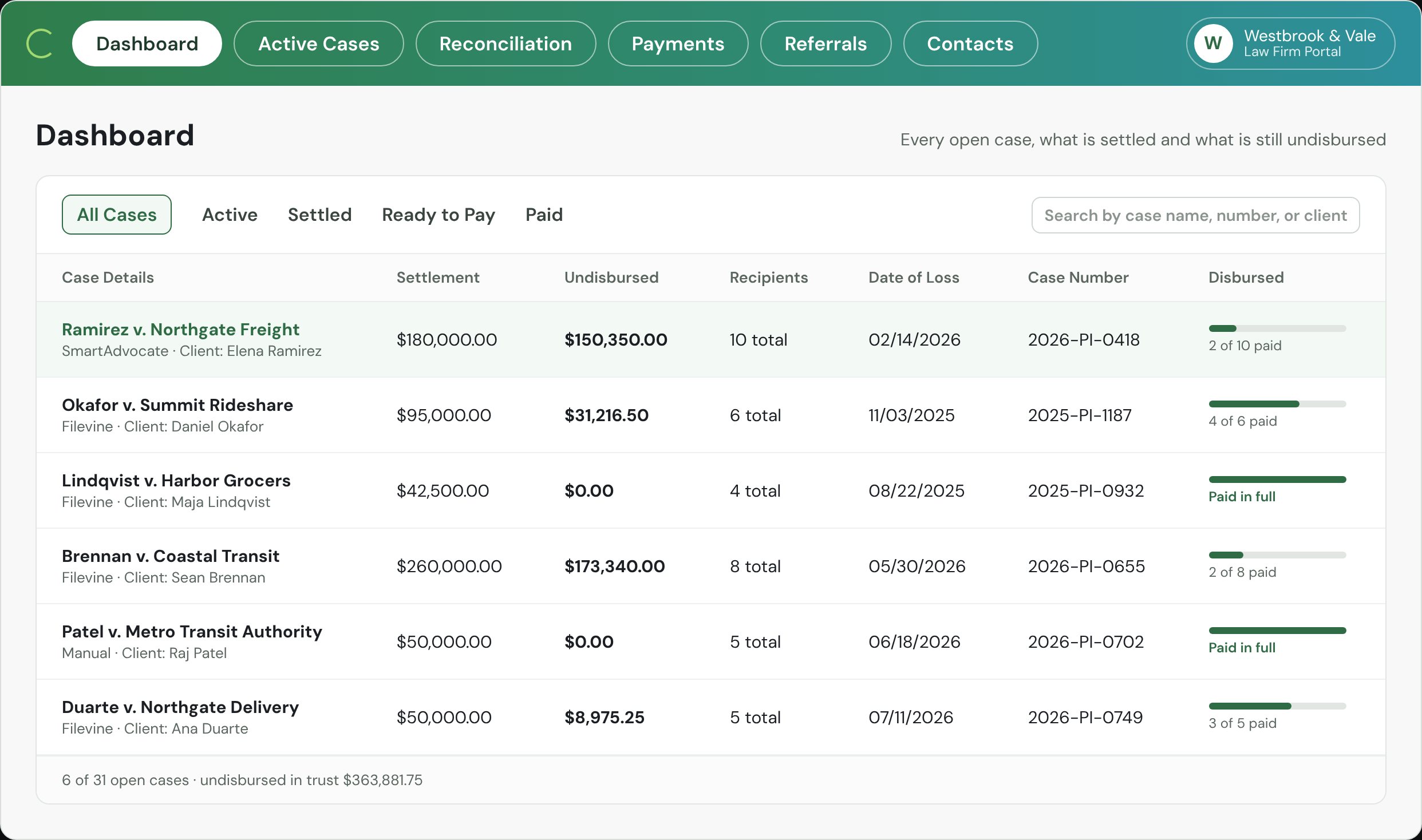
Home page. Illustrative.
1. Every case, and what is still undisbursed
Every open case imported from your case system: settlement on the left, undisbursed on the right, how many recipients are paid.
Connected to your books: a check sent from somewhere else and matched to the case still reduces the undisbursed balance here.
Accounting already knows this number for every case; this puts it in front of the attorneys too, until the case hits zero.
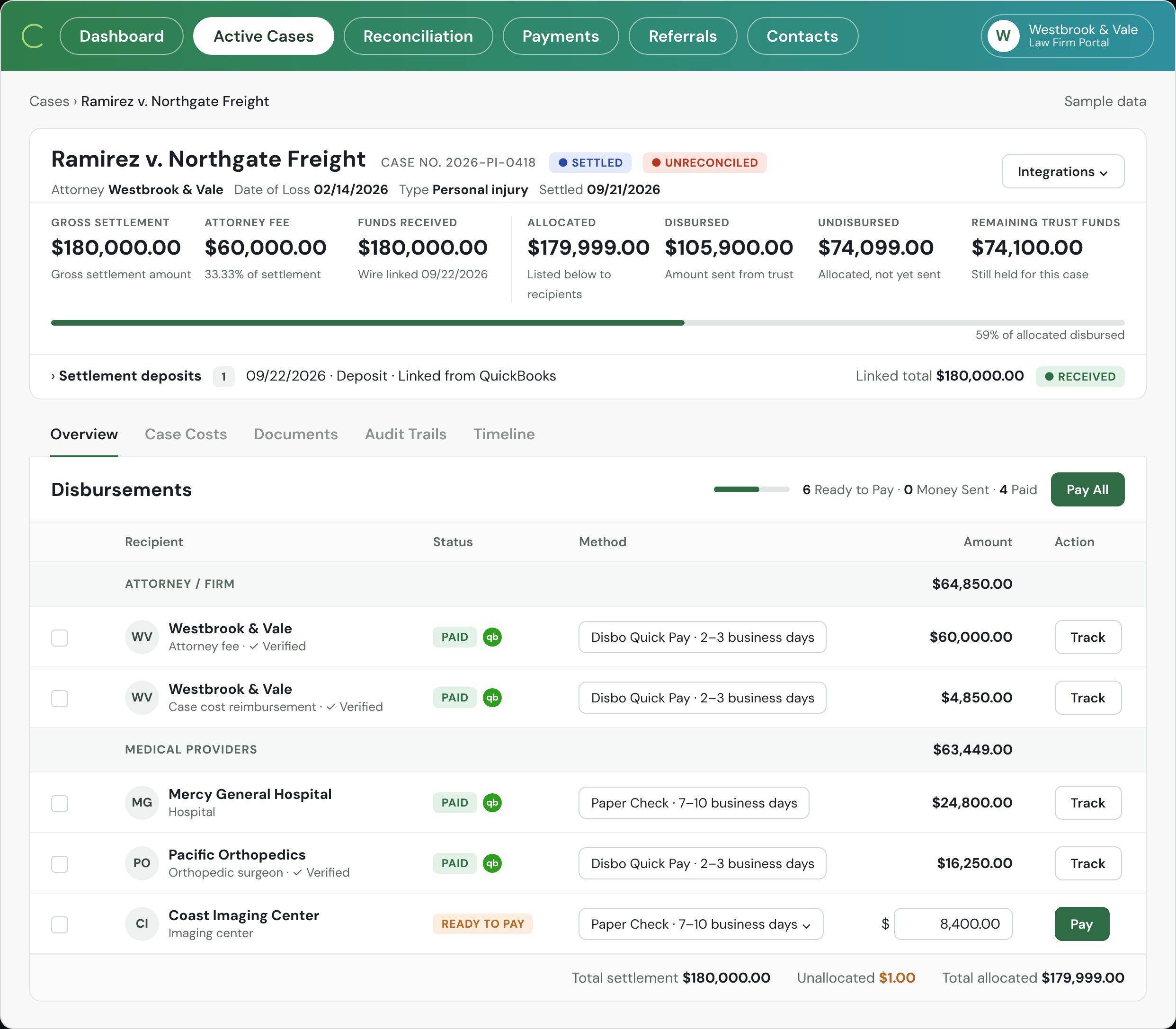
Linking the deposit to the case. Illustrative.
2. The deposit is linked, and the sheet has to tie
Match the deposit to the case in your books, as you do today, and Disbo picks it up; or match it in Disbo and Disbo posts it. Either way, the same dollar is never linked twice.
Every recipient comes in from your case system; nothing is retyped. The payouts have to add up to the deposit before anything goes out: not a dollar more, not a dollar less.
A wrong amount (the extra zero, $100 instead of $1,000) is flagged. You can override a short amount with a reason; you can never send more than the deposit.
Medical not finalized yet? The case carries a payout 1 and a payout 2: pay the client and what is settled now, pay the rest when the liens are resolved. The unpaid part stays in trust against the case.
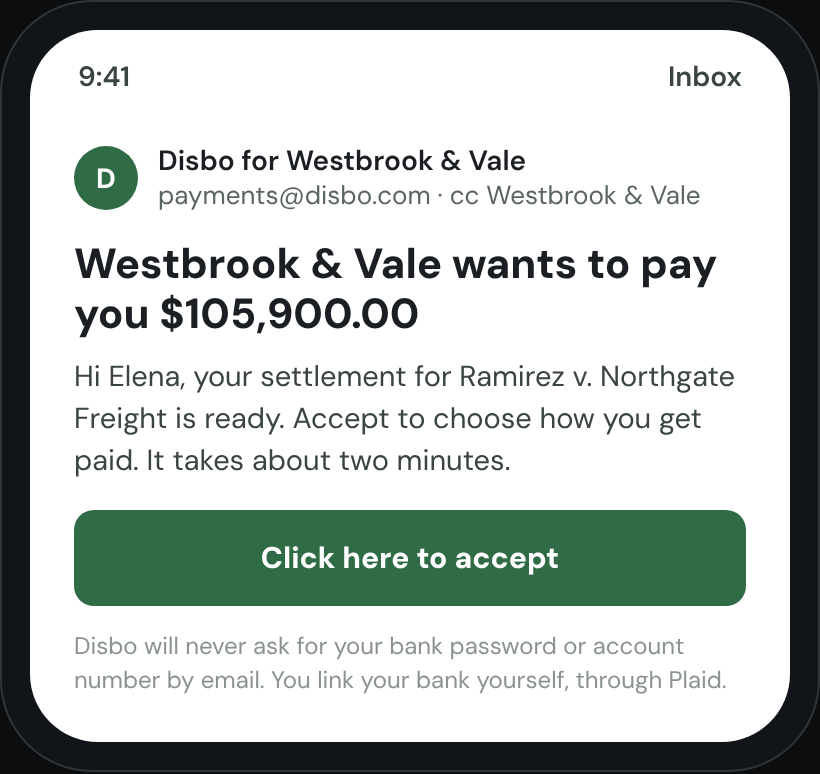
What the client sees first. Illustrative.
3. The client gets a text and an email
"Westbrook & Vale wants to pay you $55,000. Click here to accept."
Plaid opens on their phone or desktop. They pick their bank and log in the way they normally do.
About 30 seconds for the client; most accept within a couple of minutes.
Connecting the bank. Illustrative.
4. Identity verified before money moves
Plaid verifies the person behind the bank login (government ID, the name on the account) and returns the result to Disbo.
Disbo never sees the real account and routing number. Plaid hands over a token for that payee.
You see the verification before you press pay. Then ACH; the money lands in 2–3 business days.
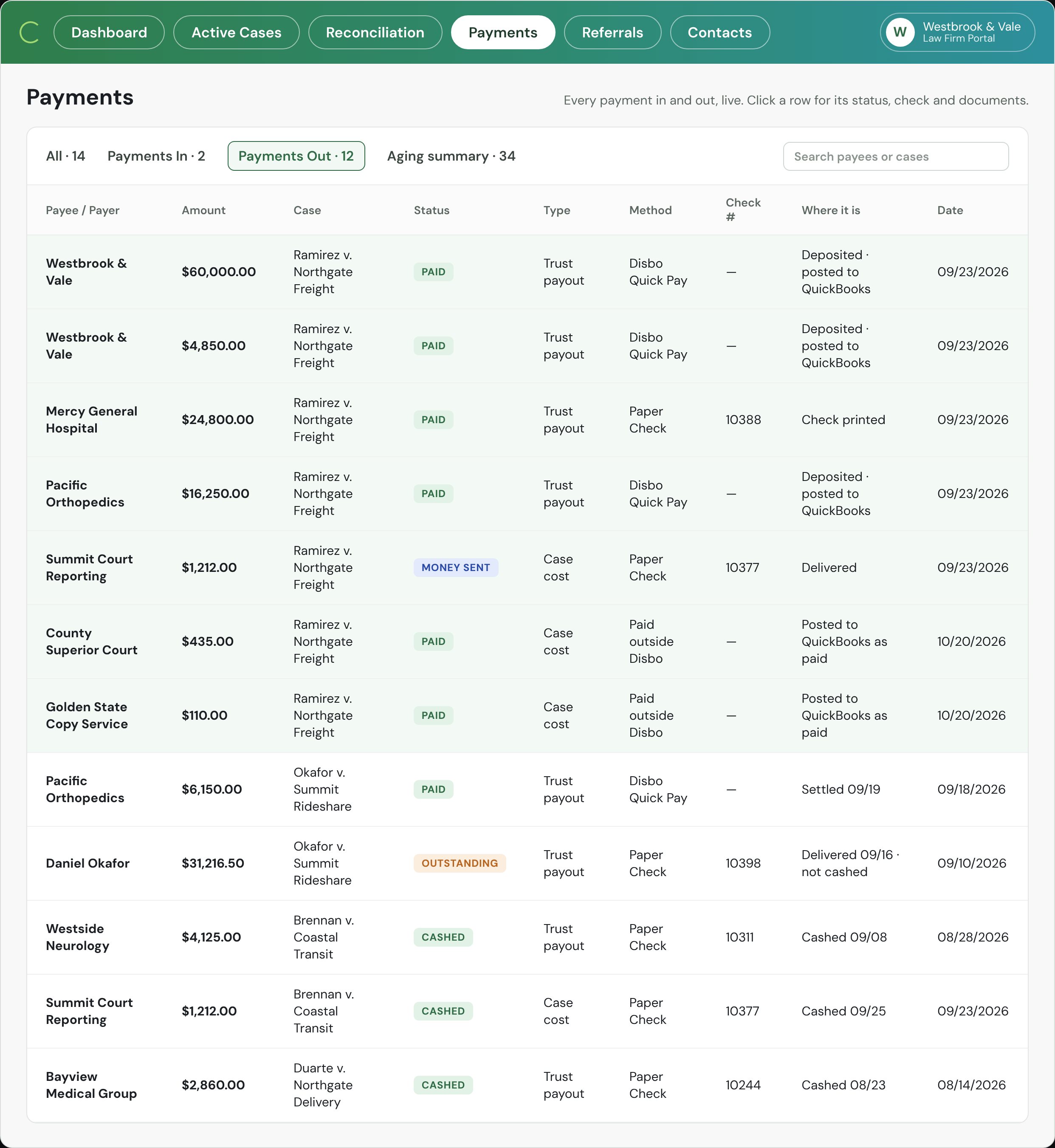
Payments list. Illustrative.
5. One list of every payment
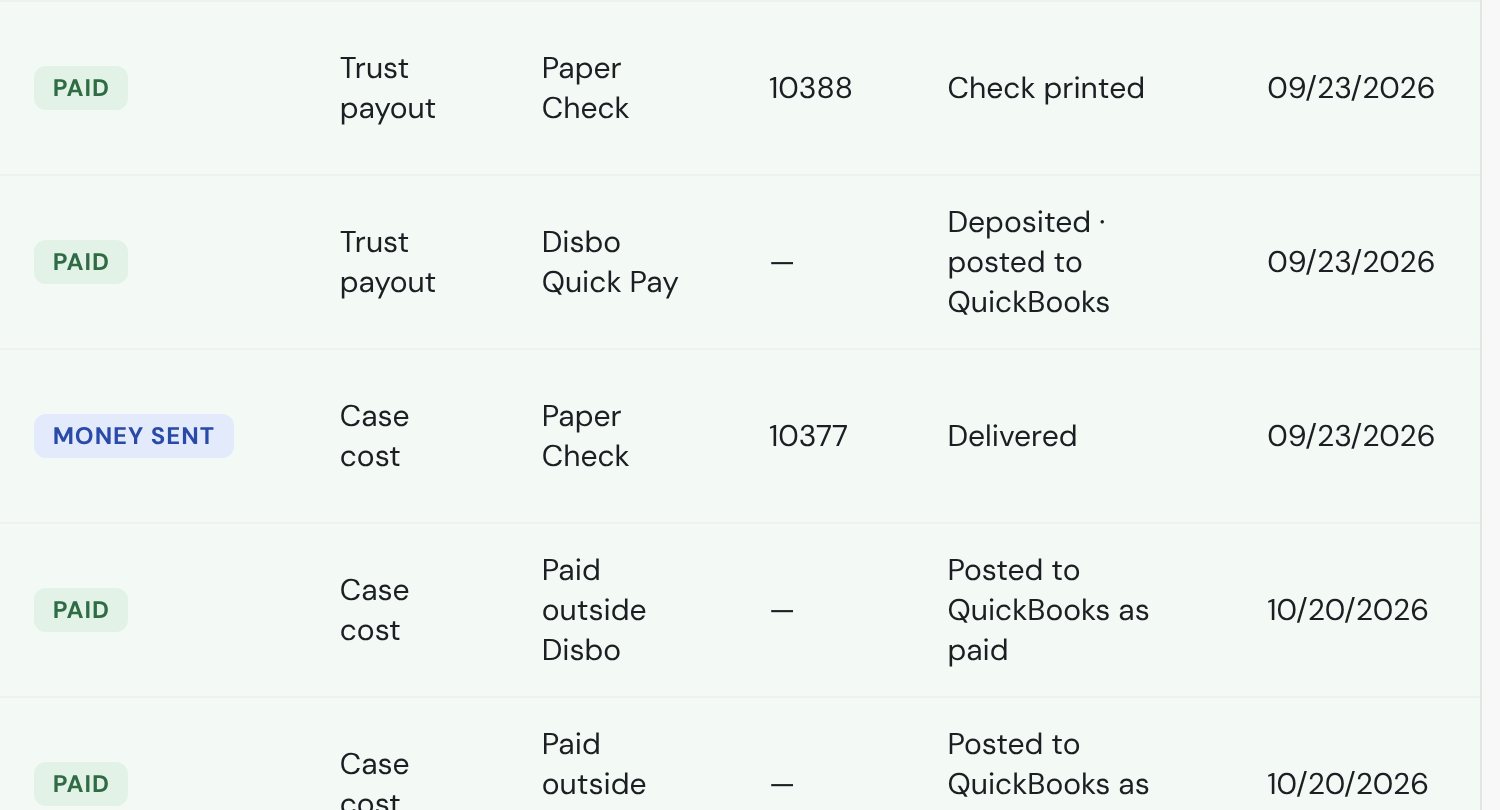
Every payment with its status: queued, approved, sent, delivered, cashed — or sent and settled for ACH. You know it went out and you know it was received.
Clients who still want a check get a check; same list, same statuses.
Every payment carries the case number, so it lands in your books and your case system already labeled.
02 · Paying medical providers and lienholders
Most providers still want checks. Disbo prints and mails them from your trust account and tracks each one to cashed.
Check details. Illustrative.
6. The check, and what goes out with it
Pick ACH or mailed check per recipient, then press pay. No printing, no envelopes, no stack on an attorney's desk.
Who the check is made out to, an attention line, the memo, and the documents mailed with it (settlement statement, reduction letter), picked straight from the case in your case system.
Several addresses per provider and partial payments are set on the payment.
Checks are drawn on your own trust account. A printing and mailing partner prints and mails them for you; no third party holds your money.
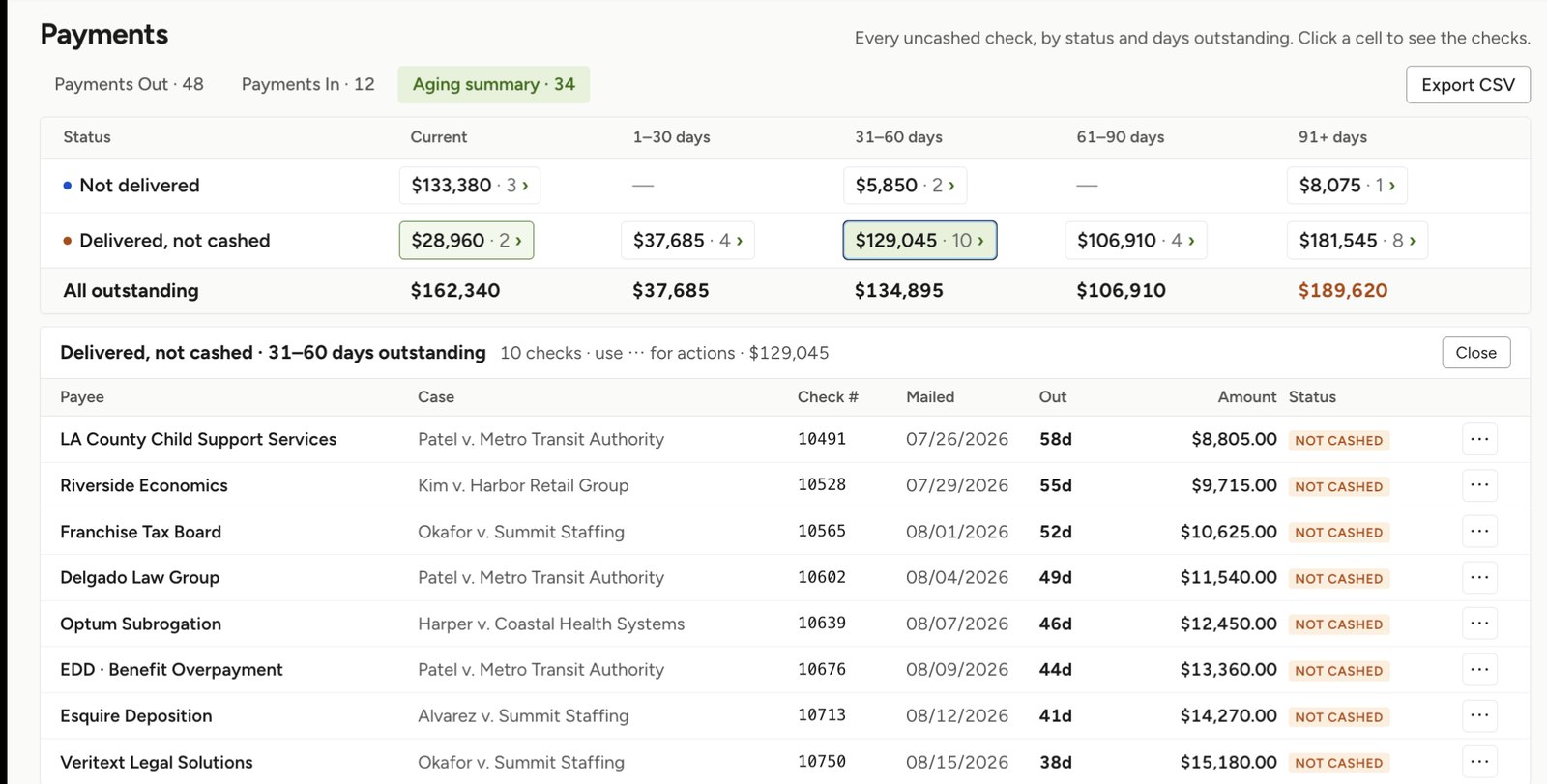
Aging summary. Illustrative.
7. Delivered? Cashed? You know, per check
Send 150 checks on a Monday and see which were delivered and which were deposited, with USPS tracking on each.
An aging report at 30, 60 and 90 days of checks delivered but not cashed, and checks never delivered, so you void and reissue in weeks instead of months.
Click into any check for its history; reissue from the row; the void list goes to your bank.
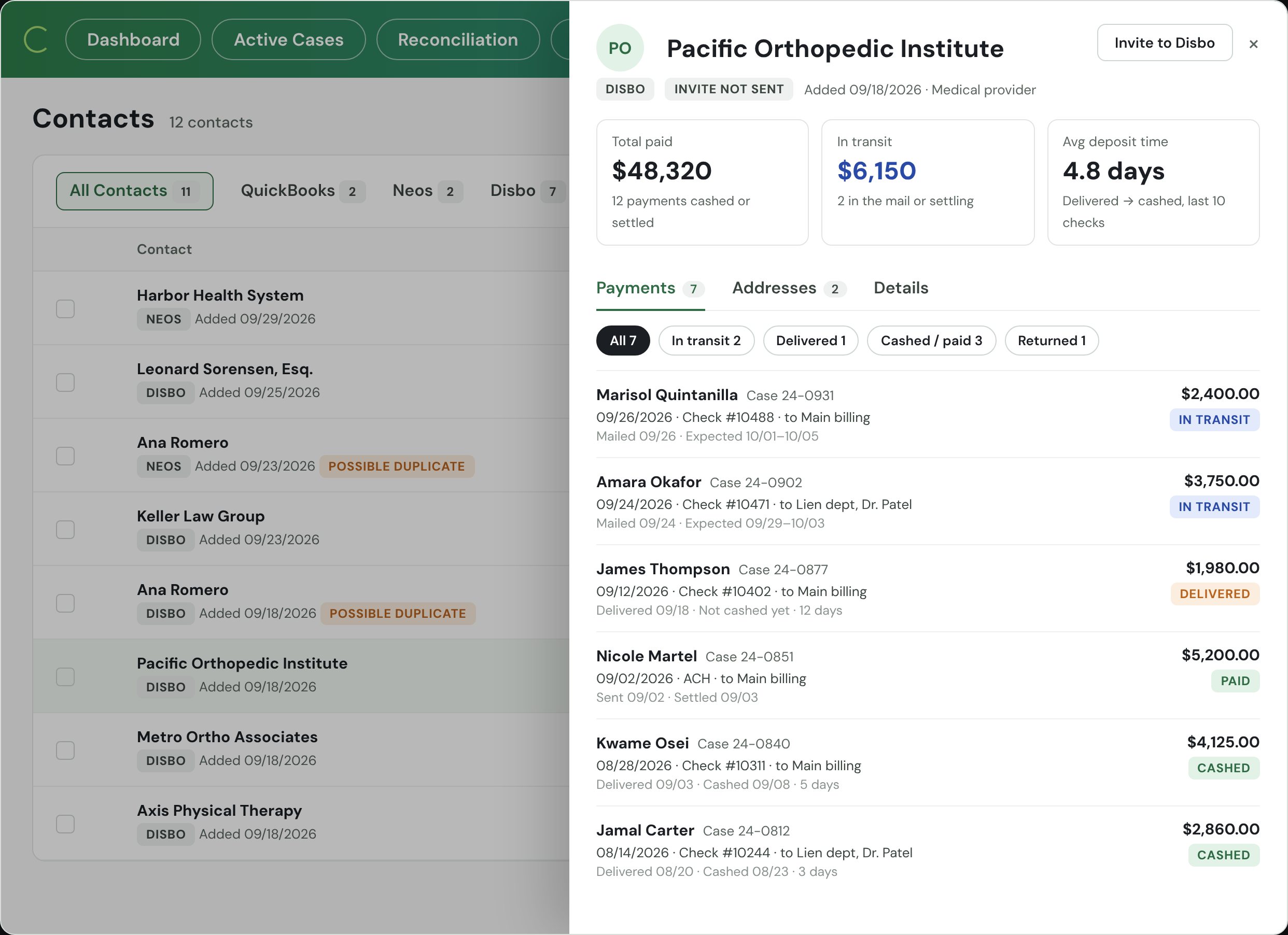
Contacts. Illustrative.
8. Contacts, and getting providers off checks
Your providers come in from your case system or your books, wherever your contacts live, merged into one list with their addresses and payment history.
Every check we mail carries an insert inviting that provider to link a bank once. Once they do, they are paid by ACH from then on, with no fee to them.
Each payment has a status link the provider can open.
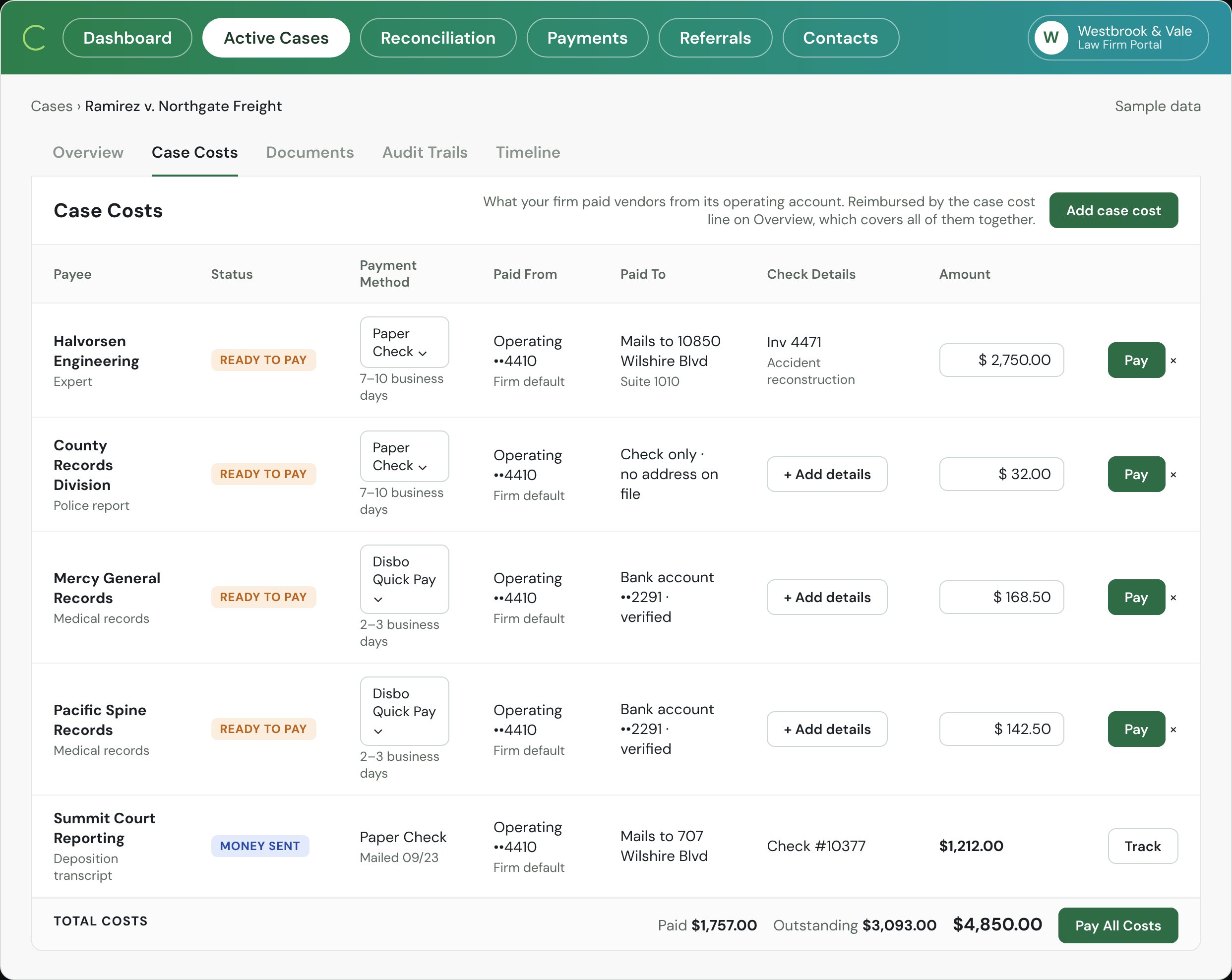
Case costs. Illustrative.
9. Case costs, the same way
Records requests, police reports, experts: the request comes in from your case system, shows up in Case Costs, you review and press approve and pay.
Paid from operating, never from trust. Posted to your books and written back to the case, so the cost is on the case the day it is paid and recovered at disbursement.
03 · The books and the trust account
Bank statement, trust journal, per-case ledgers. Posted as it happens; reconciled in beta.
Inside QuickBooks
Ramirez, Elena — 24-0931QuickBooks Online · Trust customer ledger · Ramirez v. Northgate Freight
RegisterTrust companyMatter 24-0931
Date
Num
Payee
Memo
Payment
Deposit
Balance
Oct 1
DEP
Ramirez, Elena — 24-0931
Settlement deposit
$100,000.00
$100,000.00
Oct 9
10421
Northgate Spine & Rehab
Ramirez, Elena – 24-0931 · Medical provider
$38,210.00
$61,790.00
Oct 10
10422
Patel, A. MD
Ramirez, Elena – 24-0931 · Medical provider
$12,650.00
$49,140.00
Oct 10
10423
Anderson & Reed LLP
Ramirez, Elena – 24-0931 · Referral fee
$24,000.00
$25,140.00
Oct 10
10424
Ramirez, Elena
Ramirez, Elena – 24-0931 · Client proceeds
$25,140.00
$0.00
Posting to the books. Illustrative.
10.your books stays your chart of accounts
Nothing moves out of your books. Every payout, deposit, void and reissue is posted there with the case number and payee, the moment it happens, in your memo format.
QuickBooks Online, QuickBooks Desktop (a custom-built connection set up with our team), Sage Intacct, NetSuite and Xero.
Since you keep case numbers, Disbo links on the case number across your case system, your books and Disbo; the three stay in sync for recipients, case costs and addresses.
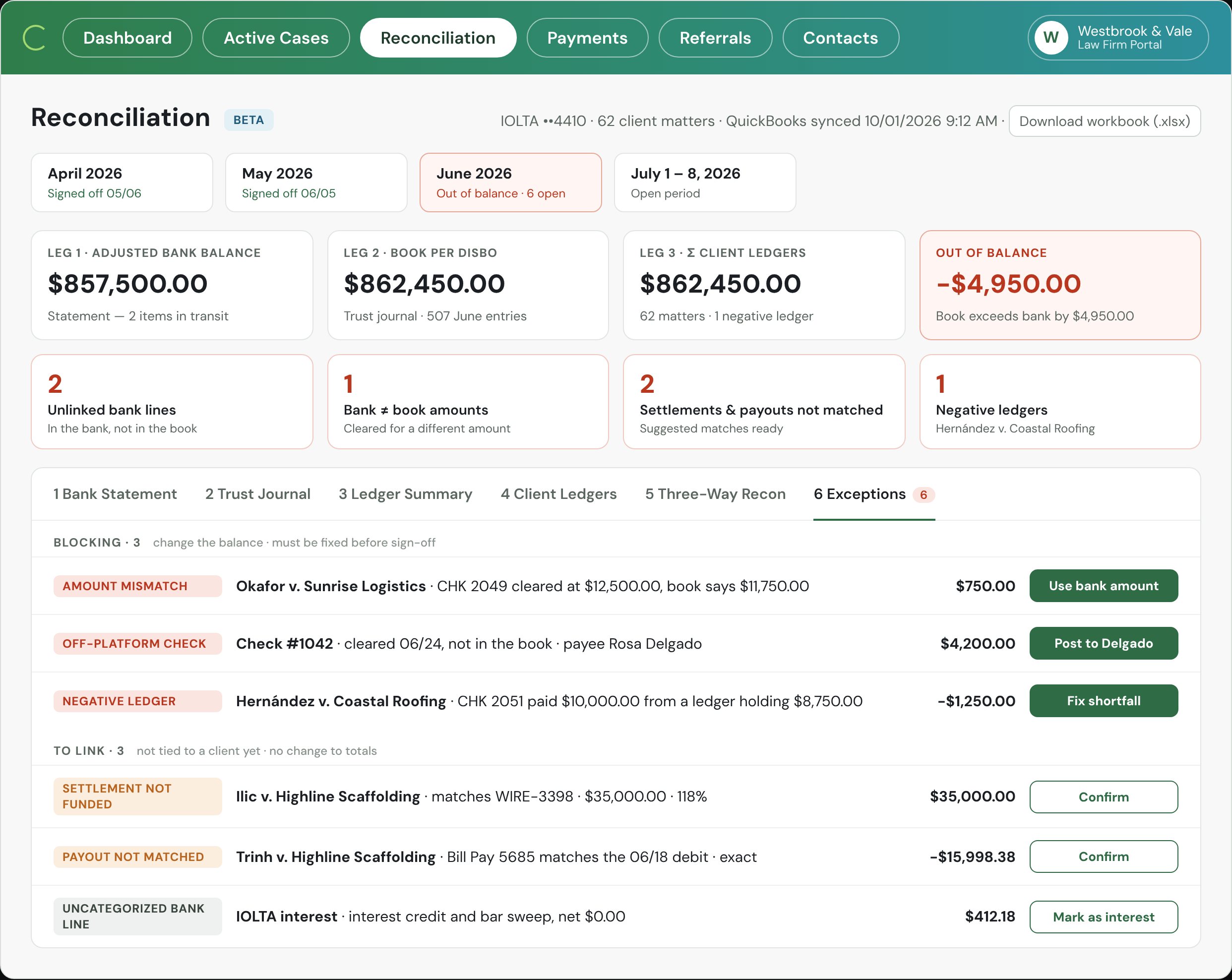
The bank statement, the trust journal (every transaction in and out, tied to a case, including checks not yet cleared) and the ledger per client, side by side. All three have to match.
Anything Disbo can't tie to a case, from the bank or from your books, is listed for your team to match.
The export is in beta with a small group of firms. Most firms keep closing in your books and use this as the check; the three-way worksheet covers the month end meanwhile.
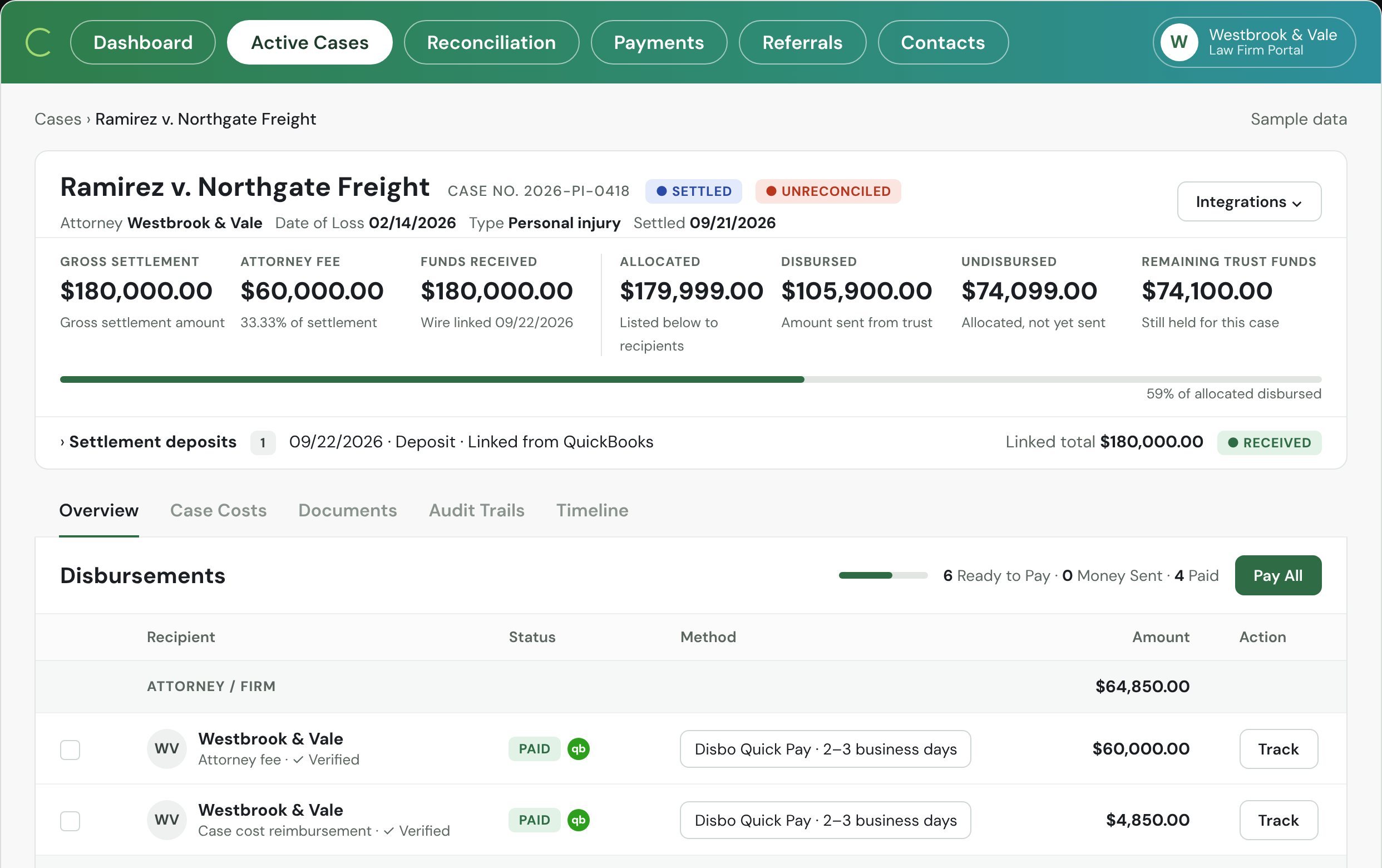
One case, reconciled. Illustrative.
12. Every dollar in trust has a name on it
Per case: deposits in, payouts out, what is left and why (in the mail, delivered not cashed, held for payout 2).
This is what makes the aging report and the undisbursed column on the home page true: the per-case ledger is built from real payment status, not from a spreadsheet.
If your books are already clean this is easy. If there is money in the trust account nobody can name, we import your cases and transactions and link them until it is named (30–45 days with years of history).
04 ·your case system, your books, your bank
your case system
↔
Disbo
↔
your books
↔
Your trust account
→
Payees
Which system is the source of truth is set up per firm. If it is your books: deposits matched there flow to Disbo and on to your case system; recipient names and amounts come from your case system.
Checks go from your own trust account straight to the recipient. A printing and mailing partner prints and mails them for you; the check is yours, drawn on your account.
ACH to a client passes through an FBO account at Cross River Bank for seconds on its way out and does not sit there. Plaid gathers the bank details as a token; Disbo never holds the real numbers. Documentation on the whole path is on the security page.
Wires are sent at your bank and recorded on the case in Disbo. International ACH, no.
Payouts must tie to the linked deposit. Short needs a reason; over is impossible.
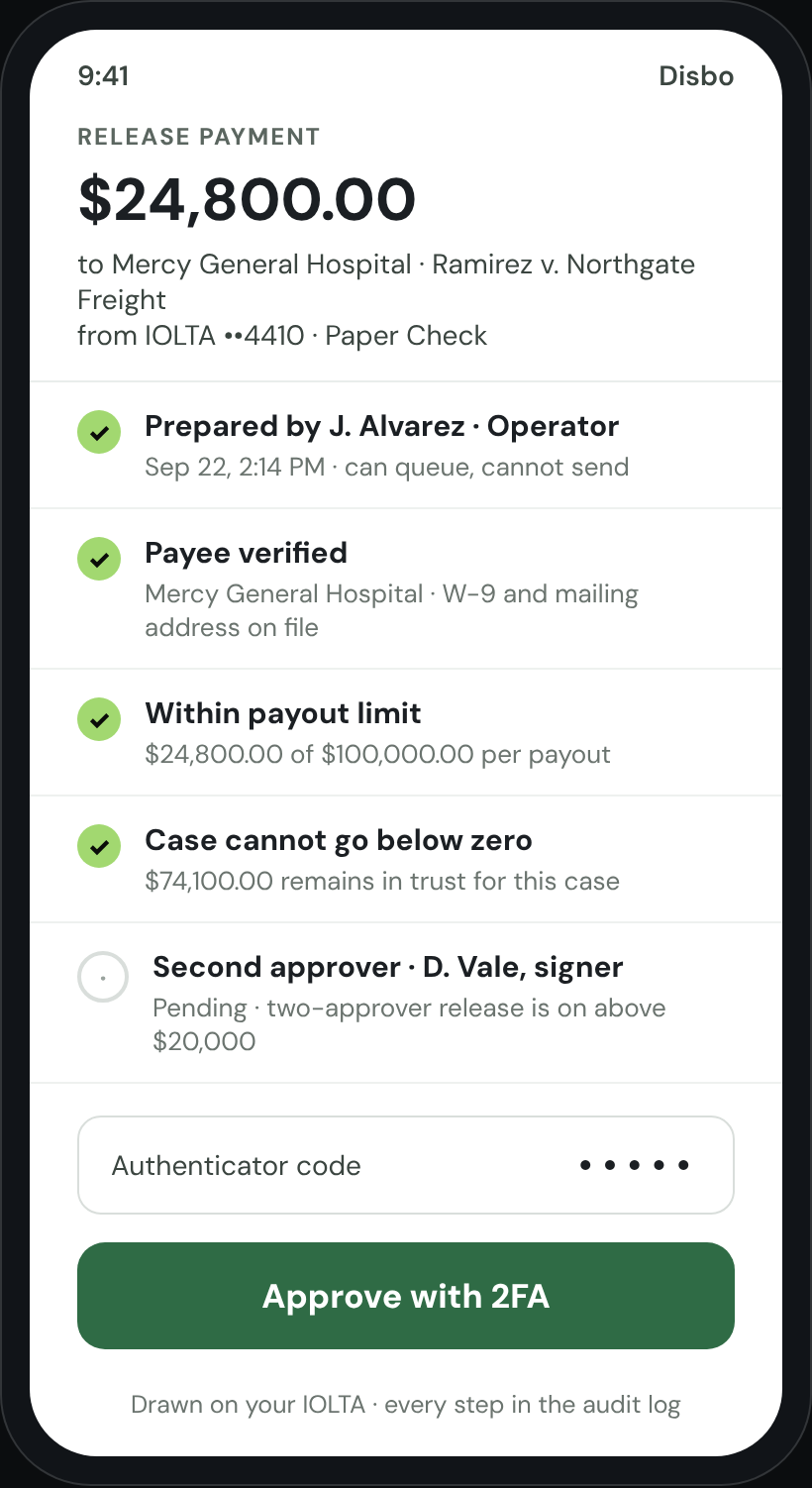
Anyone can queue a payment. Only the managing attorney, or a confirmed signer on the account, can press pay, with two-factor on every send. A second approver above an amount you set is available on request.
Stop payments and reissues
The check number is in the Payments tab the moment it is issued; send it to your bank for a stop payment, or send the void list Disbo produces in your bank's layout (set up with our team).
Void the check in Disbo; the void posts to your books in an open period and a new check is issued and sent.
What the state bars care about, and how Disbo handles it
No one earns interest on IOLTA money but the state program: nothing sits in any account along the way.
Only the attorney releases trust funds: the signer-only rule and two-factor above.
Everything else Disbo does is move data between your case system, your books and the bank, and put guardrails on each payment. The firm still does what it does today; it can't send more than the deposit.
The model was reviewed with the State Bar of California, Ellen Pansky's office and IOLTA.org. Your state's rules: /iolta-compliance.
Screens show demo data for a sample firm. Three-way reconciliation is in beta. What each case and accounting system sends and receives is stated on its integration page.